Building Clinical Precision Using the MedTech Sphygmomanometer
Early in medical training, students begin building clinical confidence through the careful practice of manual blood pressure measurement. Tools like the MedTech aneroid sphygmomanometer become part of that learning process.
Students wrap the cuff around a patient’s arm, inflate it to occlude the artery, and listen for Korotkoff sounds while slowly deflating to record systolic and diastolic pressures.
As trainees move forward, they start to notice subtle variations in readings that automated devices can miss, which reinforces the value of precision from the very beginning.
Much of this learning happens in controlled practice settings where repetition helps refine technique and reduce small errors over time.
Mastering these basics creates a strong foundation and explains why traditional methods continue to hold their place even in a technology-driven setting.
Why Learning the Dial Still Matters
Despite the prevalence of digital monitors, understanding the analog dial of a sphygmomanometer equips practitioners with the ability to verify readings independently, ensuring reliability in diverse clinical settings.
The dial's needle movement provides immediate visual feedback on pressure changes, training the eye to detect anomalies that could indicate equipment issues or patient conditions.
In educational programs, instructors stress this method to instill a sense of accountability, as manual readings demand focused attention without algorithmic shortcuts.
Recognizing the dial's enduring value naturally leads to exploring how consistent technique integrates with this foundational knowledge.
The Moment Technique Meets Consistency
The critical juncture in manual blood pressure measurement occurs when technique aligns with consistent application, transforming sporadic practice into reliable proficiency.
Practitioners must maintain steady deflation rates to capture accurate Korotkoff phases, where even minor inconsistencies can skew results and affect patient care decisions.
Consistency emerges as the bridge between novice errors and expert precision, where regular use of essential emt school supplies minimizes variability in outcomes.
MedTechKits: A Practical Approach to EMT Training Equipment
Behind consistent technique and dependable measurements stands a broader commitment to practical training, which is where MedTechKits positions itself within EMS education.
Each medkit is developed with the goal of helping EMT students and early-career providers practice with tools that feel familiar, reliable, and purpose-built for learning environments.
Rather than overwhelming learners with unnecessary features, MedTechKits focuses on supplying equipment that reinforces correct habits from the start.
By standardizing core instruments used during training, the brand helps reduce variability, allowing students to concentrate on refining technique and translating classroom instruction into repeatable performance.
The Aneroid Sphygmomanometer from MedTechKits
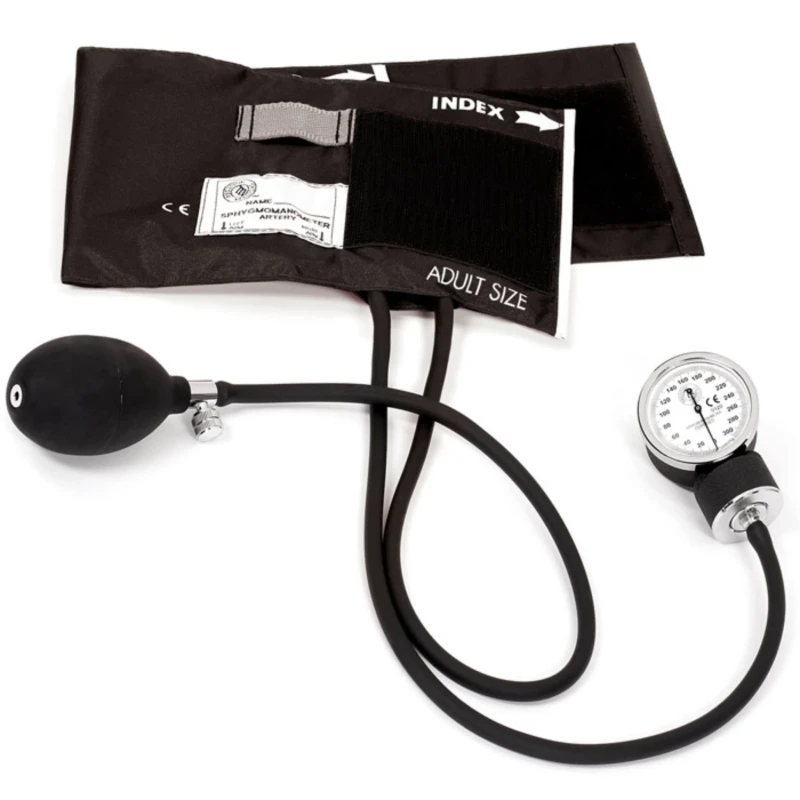
The aneroid sphygmomanometer available through MedTechKits stands out as a dedicated instrument tailored for adult arm measurements, offering a straightforward design that prioritizes educational utility.
Its compact form factor makes it ideal for classroom simulations and field training, where portability enhances accessibility for group sessions. This device embodies simplicity, allowing users to concentrate on technique without unnecessary complexities.
Focusing on its core components reveals a balance of functionality and durability, suited for those honing skills in learning environments.
Built for Daily Practice and Repeated Use
Crafted with robust materials, the sphygmomanometer endures the demands of daily training routines, where it faces constant wrapping and deflating cycles.
Its reinforced structure prevents wear from repeated manipulations, ensuring longevity through semesters of intensive use by multiple students.
In environments like EMS programs, the device's ability to handle frequent interactions without degradation fosters a reliable learning companion.
A Cuff Designed for Proper Fit and Clear Placement
The cuff features a versatile size range that accommodates various adult arm circumferences, promoting inclusivity in training scenarios.
Clear index and range markings guide users to position it correctly, minimizing errors that could arise from improper alignment.
An artery indicator mark further assists in optimal placement, ensuring the stethoscope bell aligns with the brachial artery for accurate sound detection.
In practice, these features reduce setup time, allowing more focus on the measurement itself. With the cuff secured effectively, the next emphasis shifts to the gauge's clarity in monitoring pressure.
The Gauge That Keeps Readings Easy to Track
The aneroid gauge displays pressure levels on a clear and calibrated dial, where bold numerals facilitate quick and precise readings during deflation. Its needle responds smoothly to pressure changes. This enables trainees to follow fluctuations without strain
A holder secures the gauge in place, preventing shifts that might obscure visibility mid-procedure. The gauge's design prioritizes legibility, supporting rapid interpretation essential for timed drills.
Control in Your Hand with the Inflation Bulb and Valve
The inflation bulb offers ergonomic grip for efficient pumping, allowing controlled pressure buildup with minimal effort. Paired with the air release valve, it permits fine-tuned deflation, crucial for detecting subtle Korotkoff sounds.
his duo empowers users to adjust speeds intuitively, adapting to different patient simulations. Trainees develop a feel for the controls through repeated use, building dexterity over time.
A Timeless Skill, A Trusted Tool
The journey of mastering manual blood pressure measurement begins with a simple yet powerful tool that connects theory and practice in healthcare education.
Through consistent use of an instrument designed for clarity and precision, learners develop not only technical proficiency but also the confidence to trust their own clinical judgment.
The adult aneroid sphygmomanometer represents more than just equipment; it embodies a commitment to foundational competence in an era of rapid technological change.
Paired with trusted references such as the ems field guide, this foundational tool equips providers to deliver confident, accurate care in any setting.
By embracing its straightforward design and reliable performance, practitioners carry forward a timeless ability to measure and understand vital signs with accuracy and care.
Frequently Asked Questions
Q: Can I use this sphygmomanometer for palpated blood pressures when auscultation isn't possible?
A: Yes, it's ideal for palpation. Simply inflate while feeling the radial pulse, note when it disappears then release while watching the gauge for return. This method is useful in noisy environments or when Korotkoff sounds are faint, though it only gives systolic pressure.
Q: How do I know if I'm using the right cuff size on different patients?
A: The cuff should encircle about 80% of the upper arm, with the bladder covering roughly 40% of the circumference. For most adults, the standard adult cuff works well, but always check the index and range markings to avoid over- or under-estimation of readings.
Q: Should I prefer a manual aneroid sphygmomanometer over a digital one for EMS work?
A: Manual aneroid devices are often favored in training and fieldwork because they allow you to verify readings independently and avoid reliance on batteries or electronics that can fail. Many experienced paramedics use manual methods as the gold standard for accuracy, especially when digital devices give questionable results.
Q: How do I avoid common mistakes that lead to falsely high or low readings?
A: Inflate only 30 mmHg above the palpated systolic pressure, deflate at a steady 2–3 mmHg per second, and ensure the cuff isn't too tight or loose. Common pitfalls include rapid deflation or not resting the patient beforehand which can skew results significantly.
Supporting Gear for EMT Training
1. Clear Vision in Critical Moments: Lighting Tools for EMS Care
2. How Premium EMS Kits Help Students Build Confidence and Skills
Comments
Post a Comment